Private endpoint DNS: keep the service hostname and prove the resolver path
A private IP in a portal blade is only one part of the connection. Trace the hostname from the workload to the linked private zone.
24 Jan 2026, 23:01 UTC
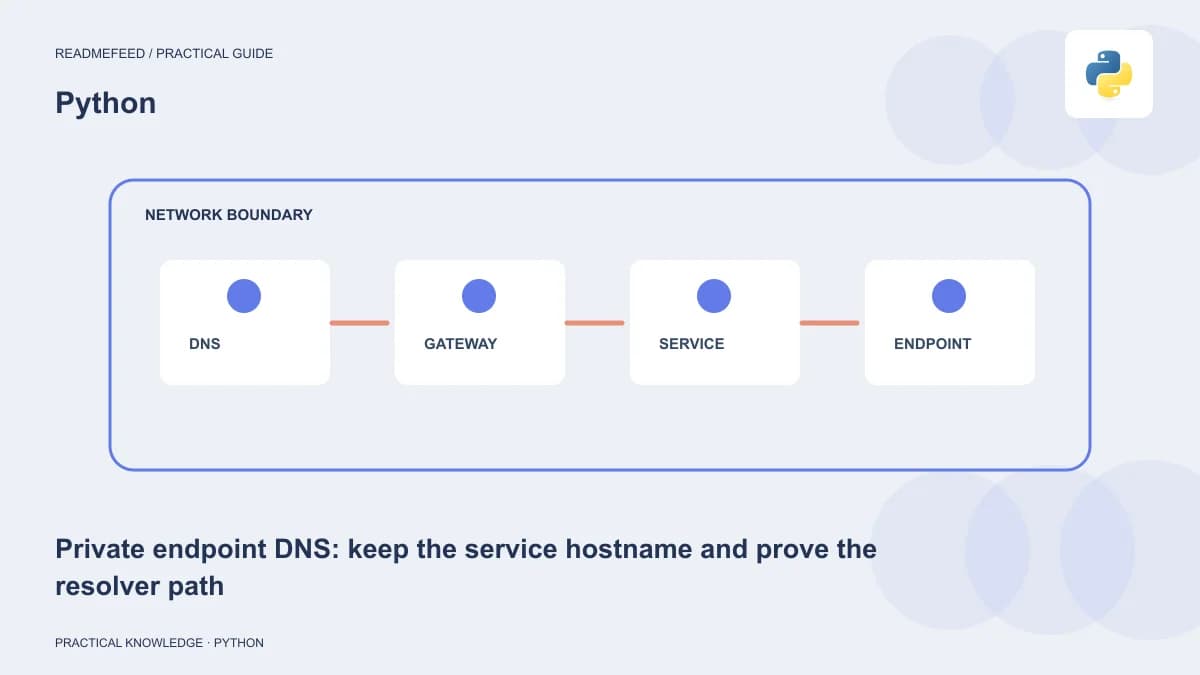
A private endpoint can exist and still be unused by an application. The application connects to a hostname, and DNS decides which address it receives. Treat the endpoint, zone records, VNet links and resolver forwarding rules as one path. Changing the application to a private IP hides the broken part of that path and creates another configuration to maintain.
Start where the failing request runs
Record the exact service hostname from application configuration. Resolve it inside the affected workload environment and compare the result with a machine in a network known to have access. For Azure Blob Storage, keep the normal account.blob.core.windows.net hostname. Azure’s DNS chain can lead to a private address when the appropriate private zone is visible. The application should not replace the service hostname with a privatelink hostname.
A public result from outside the VNet is not automatically wrong. Split DNS intentionally permits different answers for different network contexts. The useful question is whether the production workload sees the intended private address and has a route to it.
Check links and forwarding separately
Verify that the private zone contains the record corresponding to the endpoint and that the necessary VNet link exists. With custom DNS, check the conditional forwarding path and where Azure’s private-zone resolution occurs. A VNet link alone does not force an arbitrary custom DNS server to consult that zone.
Record the resolver address as well as the answer. If two machines receive different answers, compare their DNS configuration, network placement and cache state before editing records. Repeat the lookup after the relevant TTL or a controlled local cache refresh. Do not remove unrelated zone records while diagnosing one service.
DNS success is not service authorization
Once the name resolves privately, test the required service port from the workload. Then inspect the service response. A timeout suggests a different layer from a clear authorization failure. Storage data-plane roles, network rules and the choice of storage subresource still matter. A blob endpoint does not automatically provide private access to every other storage service.
Validate the completed change with a real, minimal application operation using its runtime identity. Keep TLS hostname verification enabled. Document both the DNS result and service result so a future operator can tell a resolver regression from a permission regression.